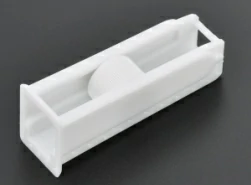
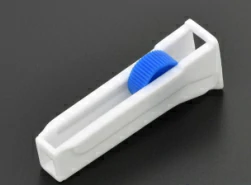
The Dual-Row Tube Clamp (Mixed Sizes) (TS-006) offers a reliable single-use connection, stable dimensions and smooth sealing surfaces, molded from acetal (POM) for IV infusion sets and tubing flow control. ' . bfaq_company_name() . ' supplies it with consistent lot-to-lot quality and OEM/ODM options.
Definition
At its core, a dual-row tube clamp (mixed sizes) is a molded plastic component that creates or controls a connection in a medical fluid line. It is engineered so that tubing, syringes, devices and accessories join with a predictable, leak-resistant fit, and it is produced as a single-use part from medical-grade thermoplastics.
The component is small, but it carries real responsibility: a poor seal or an out-of-tolerance dimension can compromise an entire single-use assembly, which is why medical molders control material, tooling and process tightly.
It helps to picture where the part sits. A finished single-use device — an IV set, a transfer line, a dialysis circuit — is an assembly of molded plastic pieces joined into one fluid path. Each piece has a narrow job, and the value of standardization is that pieces from a catalog snap together predictably, so an assembler can design around known interfaces instead of bespoke fittings.
About This Component
The Dual-Row Tube Clamp (Mixed Sizes) is supplied as a single-use molded part for IV infusion sets and tubing flow control. Its interface follows standard conventions so it mates predictably with compatible components, and it is produced in acetal (POM) by default, with other medical-grade resins available on request.
Like all Baixin Bio components, it can be customized for material, color, dimensions, packaging and assembly. For a precise specification — exact dimensions, tolerances, sterilization validation, packaging counts and minimum order quantity — request a drawing and samples through the inquiry form.
Key Advantages
Where dual-row tube clamp (mixed sizes) earns its place, it is for a handful of practical reasons:
- Available in multiple materials and colors
- Supports OEM and ODM customization of dimensions and packaging
- High-volume manufacturing with stable quality
- Compatibility with common sterilization methods
- Standardized interface that interoperates with compliant luer components
None of these advantages matter in isolation; their value is cumulative. A part that seals well but drifts dimensionally, or one that is consistent but slow to supply, fails the assembler. The point is to get all of them at once, reliably, lot after lot.
Common Applications
The settings that rely on dual-row tube clamp (mixed sizes) include:
- Disposable diagnostic devices
- Syringe and pump connections
- IV infusion sets
- Blood and fluid transfer lines
Across all of these uses, the underlying requirement is the same: a connection that is secure, leak-resistant and safe to make once and discard. That is why standardized, single-use molded components dominate the category — they remove variability from the most failure-prone part of a fluid path, the junction, and they let a device be assembled quickly and qualified as a unit.
How to Specify and Choose
When you select a component, work through these variables before requesting a quote:
- The inner and outer diameters of the tubing the part bonds to
- The sterilization method the finished device will undergo
- Whether the part is single-use or intended for limited reuse
- Color coding or opacity requirements for the assembly
- Packaging format and order volume for the program
Getting these settled early means the first samples are usable and the program moves to volume faster. When a standard part does not fit, the same variables become the brief for an OEM or ODM tooling project.
Industry Standards
Small-bore connectors for liquids and gases are governed by the ISO 80369 family, which is progressively replacing the historical luer standard to reduce the risk of misconnection between different clinical applications. Medical-grade resins are selected and documented for biocompatibility, and finished components are sterilized by validated methods such as ethylene oxide (EO), gamma irradiation or steam autoclave depending on the material.
For acetal (POM) components, the practical sterilization options are EO; the choice is confirmed against the finished device and its validated process.
Much of the modern standards work exists to prevent misconnection. Historically a single luer taper served many applications, which made cross-connections physically possible; the ISO 80369 series assign distinct geometries to different uses so incompatible lines simply will not mate. When you specify a connector, identifying the correct series for the application is therefore a safety decision, not just a fit decision.
This page is informational and does not replace device-specific regulatory or validation guidance. Confirm exact standards, biocompatibility and sterilization requirements for your product with your quality team and your supplier.
Frequently Asked Questions
What materials are used?
Depending on the part, medical-grade PC, PP, PVC, ABS, PE or POM is used, selected for the connection method, fluid path and sterilization requirement.
How is it sterilized?
Components are compatible with validated single-use sterilization such as ethylene oxide, gamma irradiation or steam autoclave, depending on the resin. Confirm the method for your device.
Is it compatible with ISO 80369?
Luer interfaces follow small-bore connector conventions. Confirm exact ISO 80369 series compatibility for your application with Baixin Bio before specifying.
What order volumes are supported?
Baixin Bio supplies disposable device assemblers in production volumes, with consistent lot-to-lot quality and export-friendly communication.
Related Products

Related Questions
Explore More
Need Medical Connectors or Components?
Baixin Bio manufactures luer connectors, valves, drip chambers, clamps, caps and tubing, with OEM and ODM customization. Send your drawings or samples for a quote.
Request a Quote