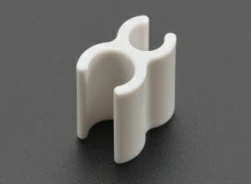
The Roberts Clamp (Large) (TS-005) is a medical plastic component used in IV infusion sets and tubing flow control. It provides a secure, single-use connection in the fluid path and is molded from acetal (POM). ' . bfaq_company_name() . ' supplies it in standard form and with OEM/ODM customization.
Definition
A roberts clamp (large) is one of the small standardized parts that make a medical fluid path work. Its job is to connect, seal or control flow between two segments of a line, and it is manufactured from device-qualified plastics for reliable single-use performance.
The component is small, but it carries real responsibility: a poor seal or an out-of-tolerance dimension can compromise an entire single-use assembly, which is why medical molders control material, tooling and process tightly.
Seen in context, the component is one link in a chain. A complete single-use set joins several molded parts into one continuous fluid path, and each junction has to seal and hold. Because the interfaces are standardized, an assembler can combine catalog parts with confidence rather than designing every joint from scratch.
About This Component
The Roberts Clamp (Large) is supplied as a single-use molded part for IV infusion sets and tubing flow control. Its interface follows standard conventions so it mates predictably with compatible components, and it is produced in acetal (POM) by default, with other medical-grade resins available on request.
Like all Baixin Bio components, it can be customized for material, color, dimensions, packaging and assembly. For a precise specification — exact dimensions, tolerances, sterilization validation, packaging counts and minimum order quantity — request a drawing and samples through the inquiry form.
Key Advantages
For device assemblers specifying roberts clamp (large), the benefits that matter most are reliability and repeatability:
- Medical-grade resin selected for fluid compatibility
- Dimensional consistency across production lots
- Smooth fluid-contact surfaces for reliable connection
- Available in multiple materials and colors
- Supports OEM and ODM customization of dimensions and packaging
- High-volume manufacturing with stable quality
In short, the component earns its place by being unremarkable in the best way: it fits, it seals, it is available, and it behaves the same every time, so engineering attention can go to the device rather than the fitting.
Common Applications
Typical applications for roberts clamp (large) span the disposable device landscape:
- Enteral feeding sets
- Laboratory fluid handling
- Irrigation sets
- Disposable diagnostic devices
- Syringe and pump connections
Across all of these uses, the underlying requirement is the same: a connection that is secure, leak-resistant and safe to make once and discard. That is why standardized, single-use molded components dominate the category — they remove variability from the most failure-prone part of a fluid path, the junction, and they let a device be assembled quickly and qualified as a unit.
How to Specify and Choose
A good specification answers a short list of questions up front:
- Color coding or opacity requirements for the assembly
- Packaging format and order volume for the program
- The connection standard the mating part uses (luer slip, luer lock or a specific ISO 80369 series)
- The working pressure the junction must hold without leaking or separating
- The fluid and its chemical compatibility with the candidate resin
With those answers in hand, a supplier can confirm a standard part or scope a custom one without back-and-forth. Sharing a drawing or a physical sample removes the remaining ambiguity.
Industry Standards
The relevant standards work is centered on ISO 80369, the small-bore connector series designed to prevent dangerous misconnections across IV, enteral, respiratory and other applications. Alongside connection standards, material biocompatibility and a validated sterilization method (EO, gamma or autoclave) define whether a component is fit for medical use.
For acetal (POM) components, the practical sterilization options are EO; the choice is confirmed against the finished device and its validated process.
Much of the modern standards work exists to prevent misconnection. Historically a single luer taper served many applications, which made cross-connections physically possible; the ISO 80369 series assign distinct geometries to different uses so incompatible lines simply will not mate. When you specify a connector, identifying the correct series for the application is therefore a safety decision, not just a fit decision.
This page is informational and does not replace device-specific regulatory or validation guidance. Confirm exact standards, biocompatibility and sterilization requirements for your product with your quality team and your supplier.
Frequently Asked Questions
What order volumes are supported?
Baixin Bio supplies disposable device assemblers in production volumes, with consistent lot-to-lot quality and export-friendly communication.
Can I request samples?
Yes. Samples and drawings are welcome and recommended before committing to volume. Use the inquiry form to request them.
Is roberts clamp (large) available for OEM or ODM projects?
Yes. Baixin Bio manufactures to drawings and samples, customizing material, color, dimensions, packaging and assembly. Send your specification for a quote.
What materials are used?
Depending on the part, medical-grade PC, PP, PVC, ABS, PE or POM is used, selected for the connection method, fluid path and sterilization requirement.
How is it sterilized?
Components are compatible with validated single-use sterilization such as ethylene oxide, gamma irradiation or steam autoclave, depending on the resin. Confirm the method for your device.
Related Products

Related Questions
Explore More
Need Medical Connectors or Components?
Baixin Bio manufactures luer connectors, valves, drip chambers, clamps, caps and tubing, with OEM and ODM customization. Send your drawings or samples for a quote.
Request a Quote